THE Microgreens History
The commercial microgreens business began in San Francisco, California, in the early 1980s. Chefs in fine-dining restaurants started using very young vegetable seedlings to make their plates look better and add flavour. They wanted to create a visual statement on the plate while adding highly concentrated aromas and textures.
Initially, they used only a few varieties like Arugula, Basil, and Radish. Because these greens were difficult to find and grown only by small local farms, they were very expensive and used mainly by luxury hotels. These farms grew them in small batches under natural sunlight, making the supply seasonal and unpredictable.
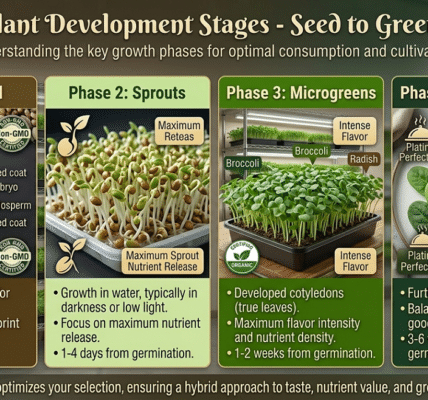
By the 1990s, growers in Southern California started producing more varieties. They began growing greens with different colours and sharp flavours, such as Beets and Mustards. During this time, growers officially started calling these crops “Microgreens.” This name distinguished them from sprouts, which had a different developmental cycle.
In 2001, new plastic containers with ventilation holes were developed. These containers allowed growers to pack and ship microgreens safely without them spoiling quickly. Because of this packaging, farms could finally sell fresh microgreens directly to supermarkets and grocery stores across state lines.
After 2010, the United States Department of Agriculture (USDA) and universities published scientific studies showing that microgreens are extremely rich in nutrients. This scientific proof turned microgreens from a simple restaurant garnish into a popular health food worldwide, establishing a permanent consumer market.
Shift to Health Foods and Commercial Use
Before these scientific studies, many people thought microgreens were just a temporary food trend. The research changed this by proving that young plants contain much higher levels of vitamins and minerals than mature plants. They represent a high-density, bio-available food source.
As a result, health-conscious consumers began buying them regularly. This shift created a stable, year-round demand, allowing growers to build profitable businesses supplying both restaurants and retail stores. Today, the global market is growing rapidly as indoor vertical farming technology improves.
The Microgreens Market in India
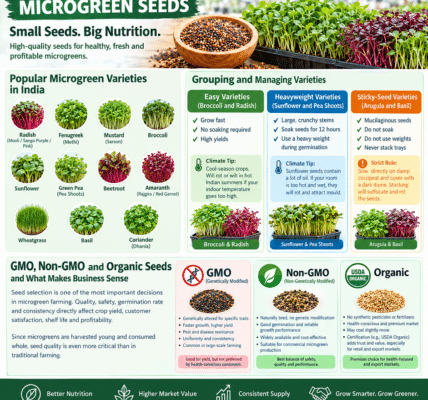
When microgreens first came to India, growers tried to copy Western methods exactly. They imported expensive peat moss, seeds, and cooling systems. This made the setup costs too high, so they could only sell to five-star hotels and expensive restaurants in metro cities.
Over the last ten years, Indian growers adapted the process using local resources:
- Local Substrate: Replacing expensive imported peat moss with washed, low-salt coconut coir (cocopeat) which is widely available in coastal regions.
- Climate Setup: Using simple air conditioning and dehumidifiers to handle high tropical heat and heavy monsoon moisture.
These local adjustments made growing much cheaper. The Indian microgreens market was valued at Rupees 400 crore in 2024 and is growing at 7.86% per year. It is projected to reach Rupees 1,100 crore by 2033. Today, anyone with a small indoor space can run a profitable microgreen farm in India.
Market Stage: Emerging but Fast Growing
The Indian microgreens market is currently considered a niche yet high-potential segment within the broader horticulture and health-food industry. Compared to countries like the USA and Europe, India’s market is still developing, but awareness has increased significantly in the last 5–7 years.
Growth drivers include:
- Rising urban health consciousness
- Expansion of premium restaurants and cafés
- Increased demand for chemical-free produce
- Social media influence on healthy lifestyles
- Growth of home gardening and urban farming
- Interest in superfoods and functional nutrition
Major metro cities such as Mumbai, Delhi, Bengaluru, Pune, Hyderabad, Chennai, and Ahmedabad are leading consumption and production.
Industrial and Processing Uses
This segment is still small in India but has strong future potential.
Industries exploring microgreens as raw materials include:
- Nutraceutical companies
- Functional food brands
- Cold-pressed juice manufacturers
- Salad processors
- Health supplement brands
- Freeze-dried food manufacturers
- Premium pet food companies
- Cosmetic and wellness brands
Potential products:
- Microgreen powders
- Extracts
- Nutritional supplements
- Ready-to-eat salad mixes
- Functional beverages
Large-scale demand may emerge as processing technologies and awareness improve as processing industries expand, demand may move from kilograms to hundreds of kilograms per week!
Advantages of Microgreen Farming in India
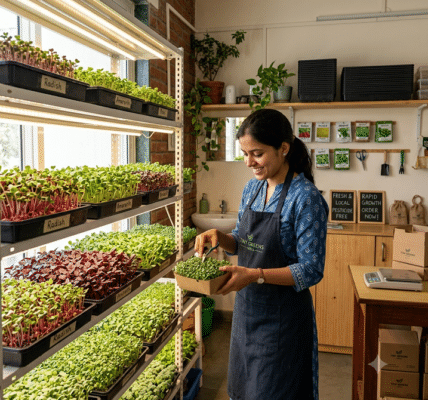
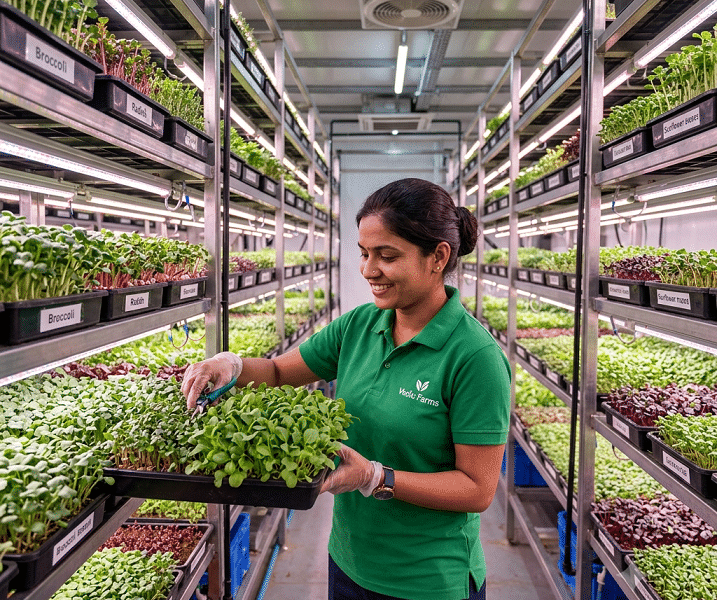
- Low Space Requirement – High production possible in small indoor spaces using vertical racks.
- Fast Crop Cycles – Most crops harvest within 12 – 18 days, enabling quick cash flow.
- Low Water Usage – Microgreens use significantly less water compared to traditional farming.
- Year-Round Production – Indoor controlled farming enables continuous cultivation.
- Premium Selling Price – Microgreens often sell at premium prices due to their nutritional and culinary value.
Challenges in the Indian Microgreens Industry
Low Consumer Awareness – Many consumers still do not understand:
- What microgreens are
- Their nutritional benefits
- How to use them
Education remains a major market requirement.
Climate and Humidity Challenges
India’s hot and humid climate can cause:
- Mould growth
- Fungal contamination
- Poor germination
- Reduced shelf life
Environmental control systems such as:
- Air conditioning
- Dehumidifiers
- Exhaust systems
- Air purifiers
are often necessary for commercial-scale operations.