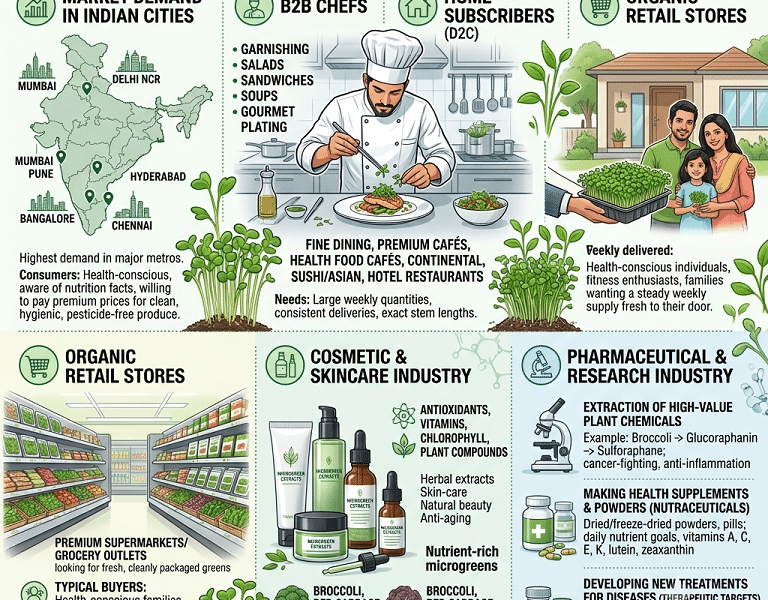
Market Demand in Indian Cities
The demand for microgreens is highest in major metro cities like Mumbai, Bangalore, Delhi NCR, Pune, Hyderabad, and Chennai. Consumers in these areas are highly health-conscious, customers are aware of the nutritional facts about microgreens and willing to pay premium prices for clean, hygenic, pesticide-free produce.
B2B Chefs:
Restorents buy in large quantities weekly, chefs expects consistent deliveries, and need exact stem lengths as per individual garnishing styles. Chefs use microgreen for Garnishing, Salads, Sandwiches, Soups, Gourmet plating
o Fine dining restaurants
o Premium cafés
o Health food cafés
o Continental restaurants
o Sushi and Asian cuisine outlets
o Hotel restaurants
Home Subscribers (D2C):
Health-conscious individuals, fitness enthusiasts, and families who want a steady weekly supply of fresh greens delivered to their door.
Organic Retail Stores:
Grocery outlets/ Premium supermarkets looking for fresh, cleanly packaged greens for their shelves.
Typical Buyers
o Health-conscious families
o Fitness enthusiasts
o Vegan and vegetarian consumers
o Working professionals
o People focused on immunity and nutrition
Cosmetic & Skincare Industry
Microgreens contain antioxidants, vitamins, chlorophyll, and plant compounds that are being explored for cosmetic applications. o Herbal extracts, Skin-care formulations, Natural beauty products and Anti-aging formulations. Right now comapnies are working on some nutrient rich microgreens which includes Broccoli, Red cabbage, Kale and Alfalfa. Cosmetic & Skincare Industry sector is still emerging but growing globally.
Pharmaceutical & Research Industry
Microgreens aren’t just for fancy salad garnishes—they are packed with powerful plant nutrients. Because of this, medical and supplement companies are using them in three major ways:
- Pulling Out High-Value Plant Chemicals (Extraction)
Young microgreens contain much higher concentrations of healthy chemicals than full-grown plants.
Real example: Broccoli microgreens are loaded with a chemical called glucoraphanin. Inside the body, this turns into sulforaphane—a compound scientists are actively studying because it helps fight cancer, reduces inflammation, and protects cells from damage. - Making Health Supplements & Powders (Nutraceuticals)
Microgreens can be dried or freeze-dried and ground into fine powders, which are then put into daily health pills or capsules.
Why it helps: These supplements offer an easy way to meet daily nutrient goals. They are packed with essential vitamins (A, C, E, and K) and eye-healthy plant pigments like lutein and zeaxanthin. - Developing New Treatments for Diseases (Therapeutic Targets)
Researchers test microgreen extracts in lab experiments (on cells and in animal models) to see how they interact with different body systems.
Future potential: These tests show that microgreen compounds could help create new treatments for major health issues, including diabetes, obesity, bacterial infections, and brain/nervous system conditions (anti-cholinergic applications).