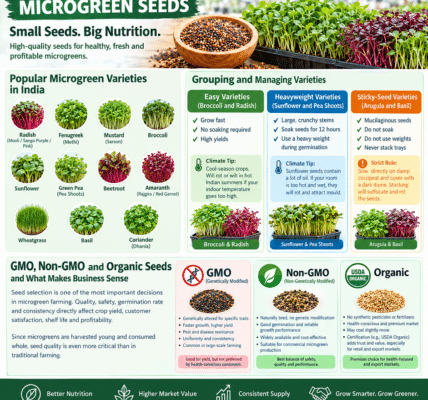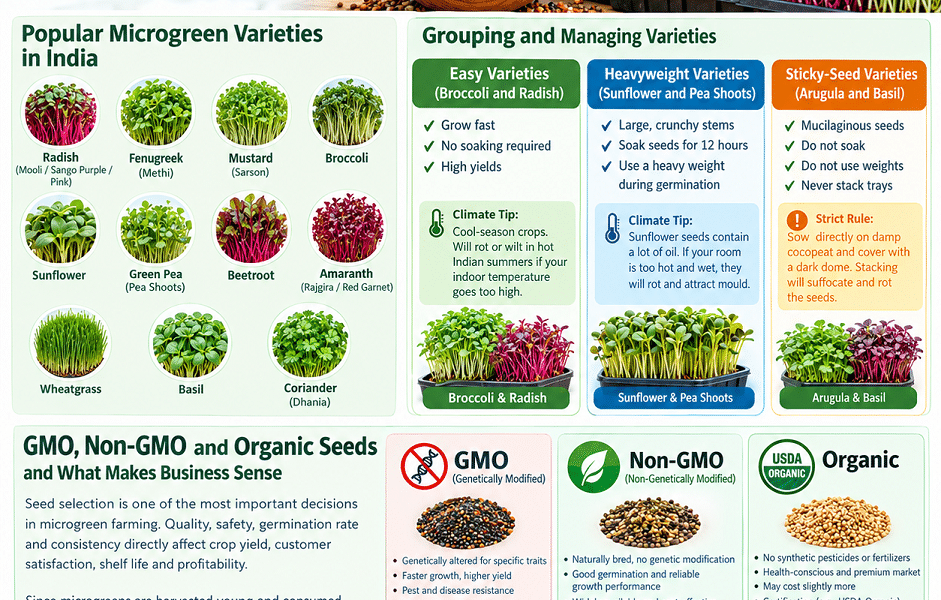
Here are some popular varieties of Microgreens in India,
- Radish (Mooli / Sango Purple / Pink)
- Fenugreek (Methi)
- Mustard (Sarson)
- Broccoli
- Sunflower
- Green Pea (Pea Shoots)
- Beetroot
- Amaranth (Rajgira / Red Garnet)
- Wheatgrass
- Basil / Coriander (Dhania)
Grouping and Managing Varieties
Easy Varieties (Broccoli and Radish)
These crops are the easiest to grow. They grow very fast, do not need to be soaked in water, and produce high yields.
Climate Tip: These are cool-season crops. During hot Indian summers, they will rot or wilt if your indoor temperature goes too high.
Heavyweight Varieties (Sunflower and Pea Shoots)
These varieties produce large, crunchy stems. They have thick seed coats, so you must soak them in water for 12 hours before sowing. They also need a heavy weight placed on them during germination to help them root deeply.
Climate Tip: Sunflower seeds contain a lot of oil. If your room is too hot and wet, they will rot and attract mould.
Sticky-Seed Varieties (Arugula and Basil)
These are mucilaginous seeds. The moment they touch water, they create a thick, sticky gel around themselves.
Strict Rule: You must never soak these seeds, and you must never place weights on them. If you stack them, they will suffocate and rot. Always sow them directly on damp cocopeat and cover them with a dark dome.
Seed Section: GMO, Non-GMO and Organic
GMO, Non-GMO, Organic Seeds and What Makes Business Sense
Seed selection is one of the most important decisions in microgreen farming. The quality, safety, germination rate, and consistency of seeds directly affect crop yield, customer satisfaction, shelf life, and profitability. In India, many new growers make the mistake of buying cheap agricultural seeds without understanding whether they are suitable for microgreen production. Since microgreens are harvested at a very young stage and consumed whole, seed quality becomes even more critical than in traditional farming.
Why Seed Selection is important in Microgreen Farming
Unlike mature crops, microgreens are grown densely and harvested within 7–21 days. Any problem in seed quality becomes immediately visible.
Poor seed selection can lead to:
o Low germination rates
o Uneven growth
o Mould and fungal contamination
o Poor taste and texture
o Short shelf life
o Food safety risks
o Customer complaints
o Financial losses
Good quality seeds result in:
o Uniform growth
o Faster crop cycles
o Better yields
o Cleaner trays
o Stronger stems
o Better flavour and appearance
o Ultimately Higher market value
For commercial farming, seed consistency is extremely important because restaurants and retail buyers expect predictable quality every week.