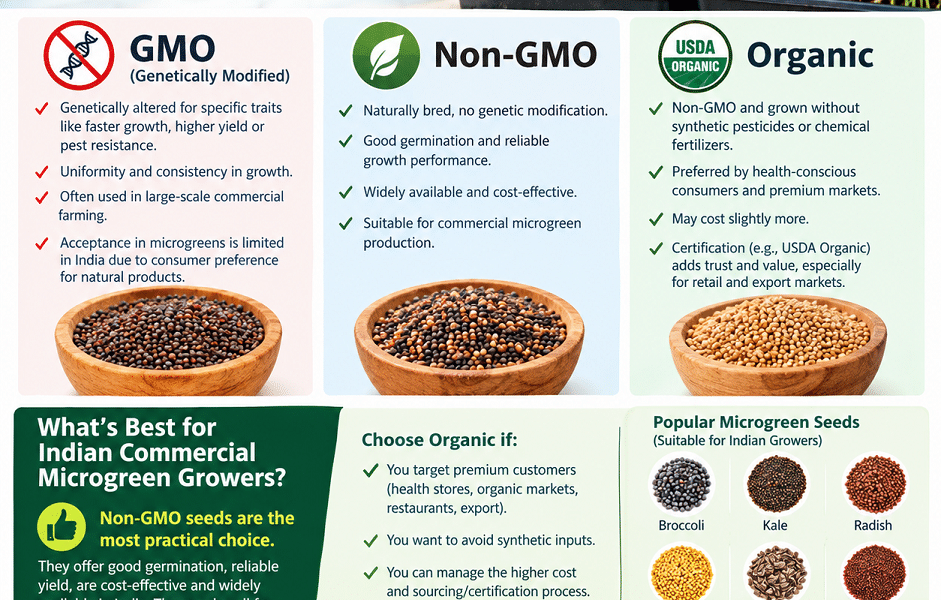
GMO, Non-GMO, Organic Seeds and What Makes Business Sense
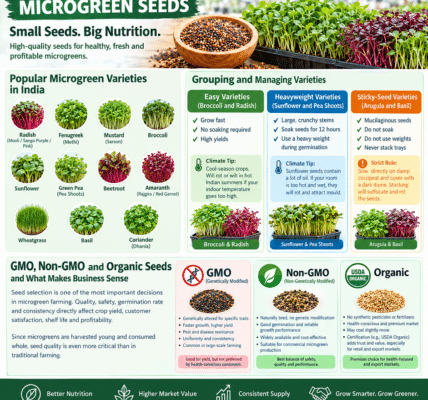
Seed selection is one of the most important decisions in microgreen farming. The quality, safety, germination rate, and consistency of seeds directly affect crop yield, customer satisfaction, shelf life, and profitability. In India, many new growers make the mistake of buying cheap agricultural seeds without understanding whether they are suitable for microgreen production. Since microgreens are harvested at a very young stage and consumed whole, seed quality becomes even more critical than in traditional farming.
Why Seed Selection is important in Microgreen Farming
Unlike mature crops, microgreens are grown densely and harvested within 7–21 days. Any problem in seed quality becomes immediately visible.
Poor seed selection can lead to:
o Low germination rates
o Uneven growth
o Mould and fungal contamination
o Poor taste and texture
o Short shelf life
o Food safety risks
o Customer complaints
o Financial losses
Good quality seeds result in:
o Uniform growth
o Faster crop cycles
o Better yields
o Cleaner trays
o Stronger stems
o Better flavour and appearance
o Ultimately Higher market value
For commercial farming, seed consistency is extremely important because restaurants and retail buyers expect predictable quality every week.
Seed Section: Best Practices for Microgreen Seed Selection in India
Types of Seeds Used in Microgreen Farming
Microgreen seeds generally fall into three categories:
- GMO Seeds
- Non-GMO Seeds
- Organic Seeds
Understanding the differences helps growers make better business decisions.
- GMO Seeds: What Are GMO Seeds?
GMO (Genetically Modified Organism) seeds are seeds whose genetic material has been altered in laboratories using biotechnology techniques.
These modifications are usually made to improve:
- Pest resistance
- Herbicide tolerance
- Disease resistance
- Shelf life
- Productivity
Common GMO crops globally include:
- Corn
- Soybean
- Cotton
- Canola
Are GMO Seeds Common in Indian Microgreen Farming?
In India, GMO seeds are generally not common in microgreen farming.
Important points:
- Most microgreen varieties sold in India are naturally bred and non-GMO.
- India has strict regulations on GMO food crops.
- Bt-Cotton is widely approved in India, but most edible GMO crops are not commercially common.
- Many imported seed suppliers mention “Non-GMO” mainly for export standards and customer confidence.
As a result, most microgreen seeds available in India are already NON-GMO by default.
Advantages and Disadvantages of GMO seeds in Microgreen Farming
Advantages of GMO seeds in Microgreen Farming
- Improved disease resistance
- Higher stress tolerance
- Better uniformity
- Mostly designed for large-scale field agriculture
Disadvantages of GMO seeds in Microgreen Farming
- Health-conscious consumers often prefer non-GMO foods.
- Premium restaurants and wellness brands usually prefer Non-GMO, Chemical-free produce
- GMO microgreen-specific seeds are rarely available in India.
- Marketing GMO microgreens can be difficult in premium markets.
Business Practicality of GMO Seeds in India
For Indian microgreen businesses, GMO seeds usually do not provide major commercial advantages. Most growers avoid them because premium buyers prefer natural produce, on the other hand availability is limited and branding becomes harder when grower use the GMO Seeds
- Non-GMO Seeds
Non-GMO seeds are seeds that have not been genetically engineered in laboratories. They are produced using traditional breeding methods.
Non-GMO seeds are the most common seeds used in Indian microgreen farming.
Advantages of Non-GMO Seeds
- Most health-conscious buyers prefer non-GMO foods.
- “Non-GMO” is considered a positive marketing term in Restaurants, Organic stores, Wellness brands and in Health-conscious communities
- Better Availability: Most Indian seed suppliers already provide non-GMO seeds.
- Lower Cost Compared to Organic Seeds while still maintaining good quality.
- Suitable for commercial scaling as it provides good germination, stable yields and provides consistent production
Disadvantages of Non-GMO Seeds
- Quality varies heavily between suppliers.
- Low-quality non-GMO seeds may contain fungicide residues, dust, broken seeds and low germination percentages.
- Therefore, supplier selection matters more than simply choosing “non-GMO.”
- Organic Seed
Advantages of Organic Seeds
- Strong Premium Branding if you are targeting Premium retail, Luxury restaurants. organic stores or planning for exports
- Organic labelling improves confidence among health-conscious buyers.
- Organic seeds are less likely to carry synthetic chemical residues.
Disadvantages of Organic Seeds
- Organic seeds are significantly more expensive.
- Not all varieties are available as certified organic.
- Commercial-scale availability can fluctuate due to inconsistent supply
- Higher seed costs can reduce profitability unless products are sold at premium prices.
Which Seed Type Makes the Most Business Sense in India?
Best Overall Choice for Most Commercial Growers: High-Quality Non-GMO Seeds. High-quality non-GMO seeds provide the best balance of cost, availability, customer acceptance, scalability and profitability. In microgreen farming, seed quality and supplier reliability are usually far more important than whether the seed is labelled organic or non-GMO.
Regardless of seed type, always check:
- Germination Rate
- Pathogen-Free Status
- Avoid chemically treated agricultural seeds.
- Seeds should be suitable for edible sprout/microgreen production.
- Older seeds lose germination strength so always check for manufacturing date
- Low-cost seeds often produce poor yields and contamination issues.